
Invite Hannah Eisenberg To Your Podcast

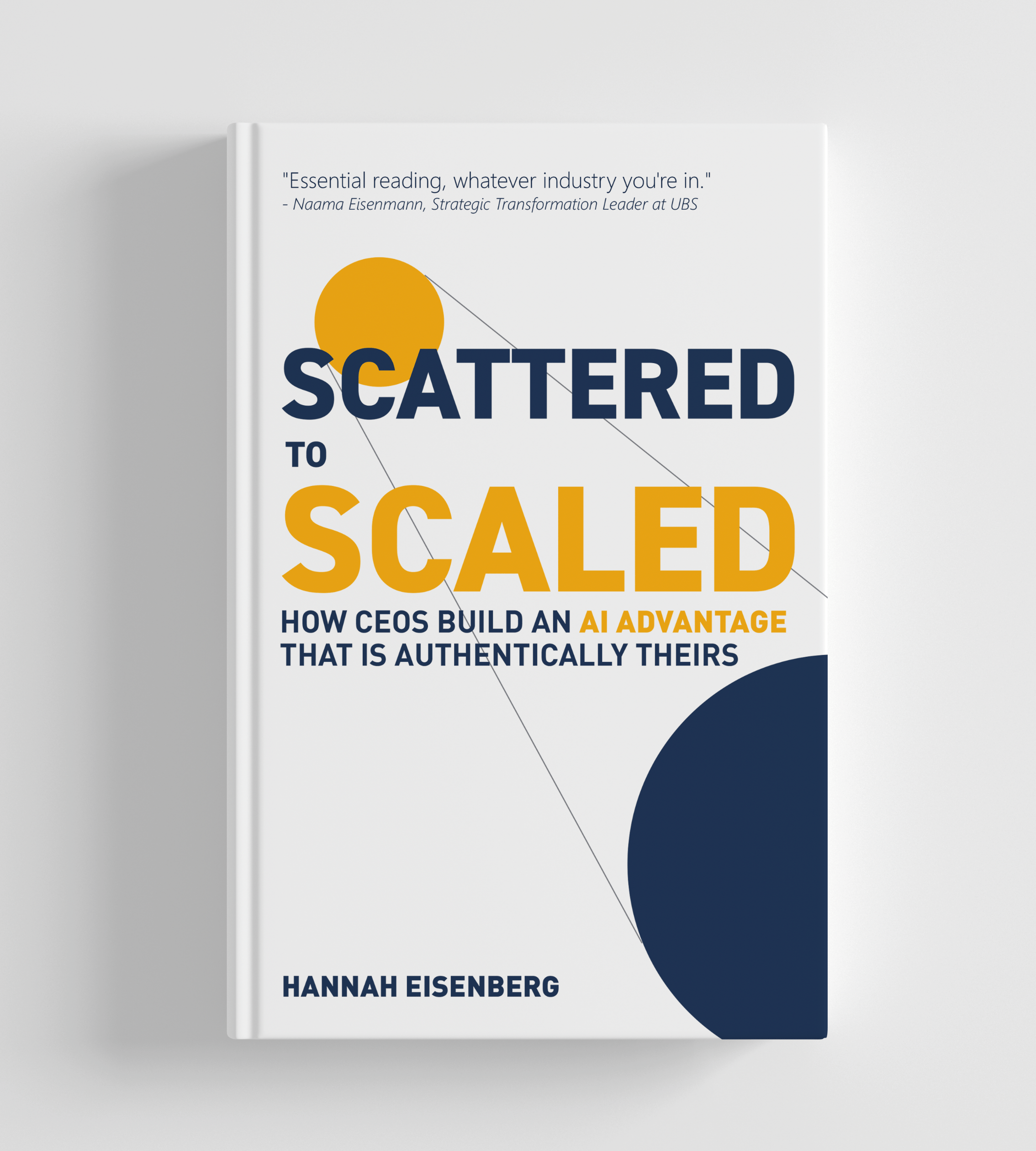
Hannah Eisenberg, dubbed the "Queen of Context," is the founder of TrustLeader and the author of Scattered to Scaled: How CEOs Build an AI Advantage That's Authentically Theirs (October 13, 2026).

She helps B2B CEOs build the context layer their AI runs on: the standards, guardrails, and decided judgment that let AI sound, decide, and act like the company. She is a Day AI partner and has spent 25+ years in B2B marketing and sales, including a decade at SAP Global Marketing.

Her message to your listeners: the companies that win with AI won't be the ones using the most of it. They will be the ones giving people and AI the right context to do better work.

IMG_4070

Topic Starters Hannah Can Confidently Talk About

I host a podcast myself. Every topic below ends with something your listeners can act on that week. Each one can be reshaped for your audience.

SIGNATURE EPISODE

Why Your Company Is Better Off Not Using AI If You Have Bad Context

Your team uses AI every day, but your revenue line hasn't moved. In my experience, the cause is rarely the tool. When AI has no written-down standards, definitions, or guardrails, it guesses, and a person has to catch the guess.

I would argue that AI with bad context costs a company more than no AI at all. This episode shows what bad context looks like, how to test for it this week, and what to write down first.

Your listeners leave with:

  • A short version of the Same Page Test: ask yourself, two colleagues, and your AI tool the same questions, then compare the answers.
  • The signs that your AI is guessing, and how to spot them in your own outputs.
  • The five things to write down first: definitions, standards, guardrails, process maps, and judgment rules.

Scaling With AI

Best for shows about: B2B growth, AI for executives, scaling a company.

The AI Efficiency Trap: Why Linear Gains Never Turn Into Compounding Returns

Efficiency gains from AI stay linear when nothing tells the AI what good looks like. This episode shows how to spot the trap in your own company and what gets you out of it.

Low-Impact Or High-Impact: Which Of Your AI Use Cases Move Revenue?

Some use cases need thin context, like drafting emails and updating content. Others depend on decisions your company has not written down yet. Listeners sort their own use cases into the two piles and see where the return sits.

Do Companies Lose Jobs To AI, Or To Competitors Who Adopted It Better?

My own expectation is that more jobs will be lost because good companies adopt AI too slowly and lose to AI-native competitors than through AI's efficiency gains. This episode makes that case and covers what a company does with its people instead: moving them toward the expensive thinking and the human work.

Context Layers

Best for shows about: AI strategy, founder-led companies, go-to-market, operations.

What Is A Context Layer, And Why Does Your AI Need One?

A context layer holds three things: the knowledge your company already wrote down, the memory your tools build from calls and emails, and the decisions leadership has made. People and AI both run on it. This episode explains each part in plain language, with no technical background needed.

Make The Judgment First, Then Let AI Scale It

Most people ask AI to make a judgment call, such as drafting an article, and then act as the human who checks and rewrites it. That targets efficiency, and the gains stay linear. Decide first, write the decision down, and AI can scale what you decided.

Which Five Things Does Every AI Need To Know About Your Company?

Your market, your customer, your offer, your proof, and your character. I call these the Foundation Five™. This episode covers the questions a CEO has to answer in each area before AI can work on the company's behalf, and how to find your own blanks.

Company Brain

Best for shows about: AI agents, revenue operations, tools and workflows for teams.

Is A Company Brain The Same Thing As A Context Layer?

A company brain stores what happened: calls, emails, meetings, documents. A context layer includes that memory and adds what leadership decided about pricing, positioning, standards, and what the company will never do.

Memory tells your agent what happened. It cannot tell it what you decided. You need both, and which one you build first depends on your situation.

One Agent Per Person, Or One Memory For The Whole Team?

When every tool and team draws from a slightly different playbook, each gives a different answer. This episode covers how to set up AI agents that share the same facts, and who in the company decides what those facts are.

How Do You Keep A Company Brain Honest As Your Business Changes?

A company brain fills with what people said last year, including the old price and the retired offer. The decided part has to be maintained by a person. This episode covers a monthly review that compares what customers and sales calls say against what the company decided.

Knowledge Management And AI

Best for shows about: knowledge management, operations, leadership, founders, and exit planning.

Why Does Knowledge Management Keep Stalling, And What Changes When AI Is The Reader?

I wrote my diploma thesis on knowledge management systems at SAP. Since then, I have watched companies write knowledge down and leave it unread. This episode covers what changes when the reader is an AI agent, and what that means for how a company writes things down.

How Do You Get What Your Best People Know Into Something Every Employee And Agent Can Use?

In my experience, a company's standards, definitions, and judgment live in the founder's head and a few others'. This episode walks through how to get them out: interviews, call reviews, and a workshop where the company decides what it will never do.

Is Your AI Strategy Also Your Exit Strategy?

A company that depends on its founder's judgment is hard to hand over. Writing that judgment down for AI also writes it down for the next owner. I would argue buyers will ask about it, and this episode covers why.

Day AI

Best for shows about: CRM, HubSpot, and Day AI users, sales technology, go-to-market engineering.

What's The Difference Between Day AI And A Traditional CRM?

A traditional CRM organizes customer data as records and fields. Day AI organizes it as a memory built from calls, emails, and meetings, which agents work from. This episode covers which kind of company fits which, including the cases where staying on a traditional CRM is the better choice.

What I Learned Running My Own Company's Customer Memory On Day AI

I run my own company's pipeline and call recordings on Day AI, and I built my first working agent in about four hours. This episode covers what I set up first, what surprised me, and what I would decide before connecting anything.

Memory Plus Decisions: What Should You Tell Your Day AI Agents Before They Act?

Day AI remembers what happened across your calls and emails. It does not know what you decided about pricing, positioning, or what you will never say. This episode shows how to write those decisions down and connect them, so an agent works from both.

Questions I Can Answer

  1. Why does AI stay stuck on low-value jobs in so many companies?
  2. What does bad context look like inside a real company?
  3. What is the difference between a company brain and a context layer?
  4. What should a CEO decide before giving an AI agent more autonomy?
  5. Day AI captures every call and email. What does it still not know about the business?

Have a different angle in mind?

Bring your listeners' questions, and I will build the episode around them. Hosts of sales and content shows: I also speak on trust-based selling, from my first book, Lead With Trust. Ask me for that topic list.

Is Hannah The Right Fit For Your Audience?

Her approach does not resonate with everyone. It resonates with listeners who run, or help run, B2B companies.

CEOs And Founders Of B2B Companies With $5-25M In Revenue

They sell considered purchases with long, complex sales cycles. They already use AI across the company and have not seen the results compound.

Heads Of Product, Operations, Sales Enablement, And Knowledge

They are asked to make AI reliable in customer-facing work. The tools are ready, and the company's standards are not written down.

Builders, Consultants, And Operators Who Implement AI

They build agents and automations for others. They find the tooling is the easy part, and that nothing is written down for the AI to retrieve.

Founders Thinking About An Exit

They want a company that runs on written-down judgment, not on the founder sitting in on every decision.

Less of a fit: Shows for companies that do not use AI yet, and episodes that want a tool comparison or a prompt list.

What Is In It For You?

I have my own podcast, so I know the drill. I handle the legwork so you can focus on the conversation.

  • Zero-friction prep. A professional headshot, intro copy, talking points, and suggested questions, ready before we record.
  • Episode amplification. After publishing, I share the episode with my email list, on LinkedIn, and in my TrustLeader community. I also cut short vertical clips for Instagram and LinkedIn.
  • 5 copies of Scattered to Scaled. Print or digital, to keep, gift to your clients, or give away on the show.

Cross-promotion runs both ways, and I make it easy.

Important: I do not pitch my services on air. Your listeners get the frameworks and one free next step if they want it.

What Does Your Audience Get?

Your listeners leave with something they can do that same week.

  • A plain-language explanation of why AI stays on low-value jobs. No technical background needed.
  • A short version of the Same Page Test. Ask yourself, two colleagues, and your AI tool the same questions, then compare the answers.
  • The Lane Test. Five yes/no questions that tell you whether a step belongs to a person, a workflow, or an agent.
  • A list of what to write down first. Definitions, standards, guardrails, process maps, and judgment rules.
  • A free next step. The Scattered to Scaled Assessment shows where their company stands.A free next step. The Scattered to Scaled Assessment shows where their company stands.

They finish knowing where their company stands and what to decide first.

Possible Podcast Intro Copy

Short version (about 55 words, easy to read aloud)

Hannah Eisenberg is the founder and CEO of TrustLeader and the author of Scattered to Scaled: How CEOs Build an AI Advantage That's Authentically Theirs. She helps B2B CEOs build the context layer their AI runs on, so it can sound, decide, and act like the company. She is a Day AI partner and spent a decade at SAP Global Marketing.

Standard version (about 150 words)

Hannah Eisenberg is the founder and CEO of TrustLeader and the author of Scattered to Scaled: How CEOs Build an AI Advantage That's Authentically Theirs (October 13, 2026). She helps B2B CEOs move past scattered, one-off AI wins by building a context layer: the standards, guardrails, and decided judgment that every workflow, agent, and employee's AI can run on.

Hannah brings 25+ years of experience in B2B marketing, sales, and competitive strategy. She spent a decade at SAP Global Marketing, where she advised the Office of the CEO on competitive strategy, and wrote her diploma thesis there on knowledge management systems. She then ran her own inbound marketing agency for fifteen years and won HubSpot's Impact Award for Best Client Growth Story.

She is a Day AI partner and the author of Lead With Trust, with a foreword by Marcus Sheridan. Based in Florence, Italy, she works with CEOs across the UK, US, Canada, and Europe.
4

What People Say About Hannah

Podcasts Hannah Was A Guest On

CONTACT HANNAH

Book A Quick Call & See If Hannah Is A Good Fit For Your Show

Tell me about your show and your listeners. I will tell you whether my topics fit, and suggest an angle if they do. If they do not, I will point you to someone who fits better.

Frequently Asked Questions

What Is Your Recording Setup?

I record with a Blue Yeti USB microphone with a pop filter and a Logitech 4K webcam, and I wear headphones.

My room is quiet, with a clean background, natural light, and no interruptions. I connect over Wi-Fi and join 10 minutes early for a sound check.

I record in Riverside by default and I am comfortable in whatever platform you use.

Are You Willing To Sign A Release Form?

Yes. Standard release forms are fine, and I am happy to sign them.

Back to top